
Columbia City Directory Holdings
Columbia city directory research begins with verified leads, not a promise of one complete shelf. The strongest modern lead is the R. L. Polk & Co. West Central Tennessee Regional Polk City Directory for 1999, followed by a locality-guide reference to Columbia & Surrounding Counties, Tennessee Polk City Directory for 2003 through 2019. Genealogy inventories also identify individual Columbia issues for 1925, 1948, 1950, 1953, 1956, and 1958, plus a 1994 Columbia, Mt. Pleasant, and Spring Hill issue. Those inventory references establish useful targets, but the physical volume or licensed database should be confirmed with the holder before a trip or request.
| Collection lead | Documented years | Where held or listed | Access path |
|---|---|---|---|
| Columbia city-directory issues | 1925, 1948, 1950, 1953, 1956, 1958 | Genealogy inventories; some 1948-1958 copies listed at Allen County Public Library | Catalog or database access, then confirm the exact copy |
| West Central Tennessee Regional Polk | 1999 | Tennessee State Library and Archives fact-sheet lead | Verify shelf or library access |
| Columbia & surrounding counties Polk | 2003-2019 | Locality-guide and TSLA lead | Verify exact volumes and access |
| Columbia, Mt. Pleasant, and Spring Hill issue | 1994 | Historic Map Works and MyHeritage inventory leads | Licensed or library database access |
Missing years matter. The accessible research does not establish Columbia’s first directory, its last printed issue, a continuous run, or a local reverse-directory year range. A city directory may also reflect a canvass or publication cycle rather than a census-day address. Treat a gap as a reason to check the Archives, library microfilm, and census schedules, not as proof that a household was absent.
Maury Archives and Columbia Volumes
The Maury County Archives Genealogical Research Library is the specifically documented local room for filling a Columbia directory gap. It offers on-site viewing or a staff-search contact. Its vertical files cover families, historic sites and businesses, houses, communities, schools, churches, civic organizations, cemeteries, genealogical histories, and industrial histories. The same library lists deed, marriage, chancery, will, and estate indexes alongside microfilm for newspapers, official records, and selected Tennessee birth and death records.
The Archives genealogy sources illustrate the historical-research setting for Columbia directory work.
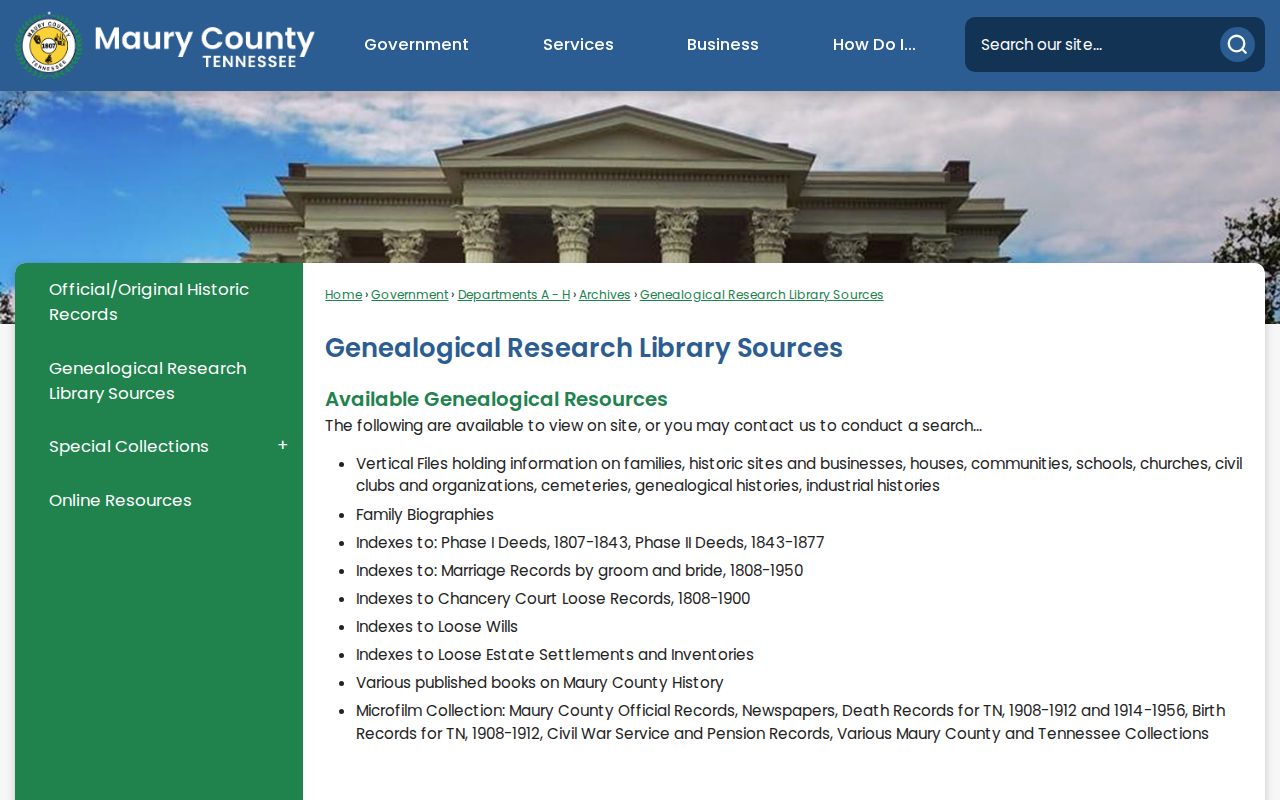
Use the directory year as the starting point, then ask staff for the matching surname, house, community, or newspaper lead in the archival indexes rather than assuming every local directory is digitized.
Maury Archives also holds original marriage licenses and bonds from 1808 to 1950, Chancery loose files from 1808 to 1900, court minutes, wills, probate material, tax records, and deed and survey indexes from 1807 to 1905. These collections can place a name in a family or property trail when the city directory gives only a line of text. Note: Staff-search availability and copy procedures should be confirmed before relying on a trip plan.
Columbia Directory Companion Files
Directory entries become more useful when placed beside the personal and institutional records kept in Maury’s special collections. Family journals, diaries, correspondence, business ledgers, DAR and Masonic records, school annuals, maps, plats, building schematics, and photographs can add a relationship, location, or time period that a listing omits. A school annual, for example, can help distinguish two people with the same initials without turning a city-directory clue into a modern identity claim.
The Maury Archives special collections show the kinds of companion material available for Columbia directory work.
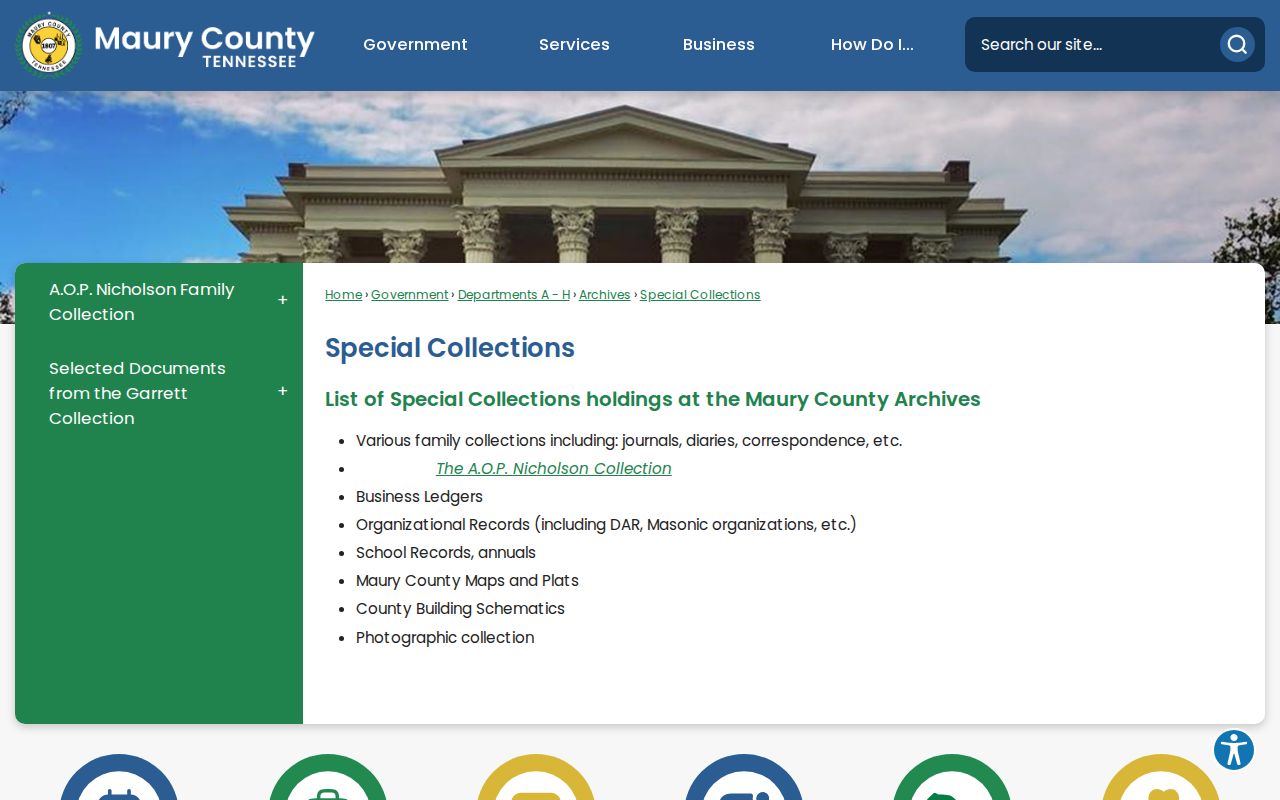
These holdings are best used to test a specific directory clue, such as a surname, organization, school, or block, while keeping the original volume and its publication year in the research notes.
Maury County Library is another practical route for newspaper and database context. Its eResources listing includes NewsBank’s America’s News with the Columbia Daily Herald, and Tennessee Electronic Library resources are also noted. The current library about information says the building is temporarily closed for renovations, so call 931-375-6502 before seeking an in-person volume or remote database access. Interlibrary loan may bring books from another library at no cost to the patron.
Digital Deeds for Columbia Directory Clues
A Columbia volume is not a deed index, but names and addresses found in it can be tested against Maury’s digitized historical deeds. The Maury County digital collections include deed collections for 1807-1843, 1843-1877, and 1878-1891. The first collection reports 12,566 deeds and the second more than 16,000. Collection records identify a person hit, role in an instrument, and original deed location or book and page reference.
The Maury digital collections landing page offers a useful next lead after a Columbia directory surname is identified.
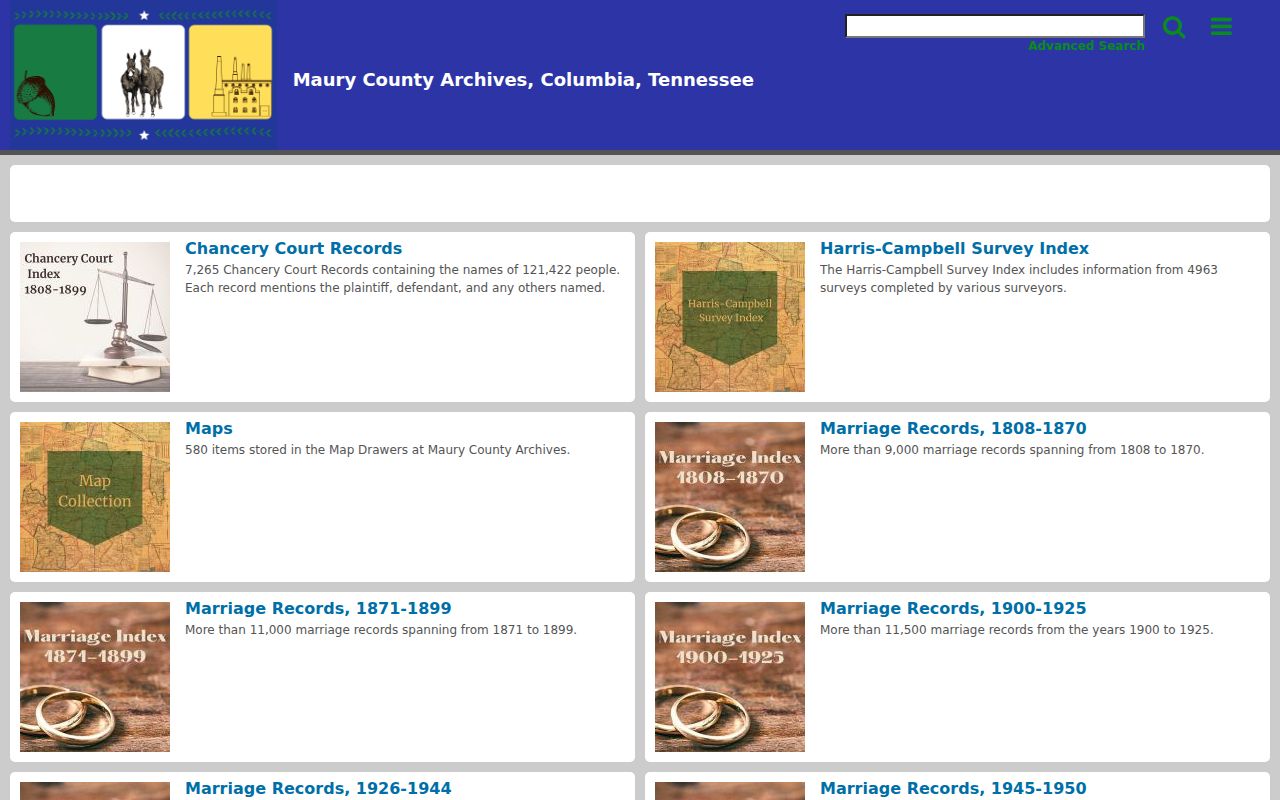
A digital index hit is a pointer, not the complete ownership story. Check the original deed book or recorder copy for the legal description, date, and context before deciding that an indexed person is the directory resident.
For current instruments, the Maury County Register of Deeds points to TitleSearcher, a vendor pay site. The historic direct and reverse deed indexes documented by TSLA run from 1807 to 1905 in microfilm. Those access layers are different: an online historical index, a vendor system, and an archive reel can each answer a different part of the same name trail.
Reading a Columbia City Directory Entry
Accessible Columbia catalog descriptions did not expose a page image with publisher-specific marks, so no single abbreviation system should be asserted for every issue. General city-directory guidance supports a careful inventory: surname and given name, a spouse or household note when supplied, an occupation or business notation, street address, telephone in telephone editions, and sometimes a widow or ownership notation. Copy the entry exactly before expanding it. The abbreviation key belongs to that particular volume.
| Name line | Record the surname, initials, and spelling exactly as printed. |
|---|---|
| Household clue | A spouse or widow notation may appear, but its form varies by publisher. |
| Address | Capture house number and street as printed, including any apartment or business address. |
| Occupation or business | Use it as a distinguishing clue, not proof of a current identity. |
| Telephone or ownership notation | Only record a mark actually present in that edition and preserve its key. |
- Criss-cross directory
- An address- or telephone-arranged section that can lead from a location to a listed name. A verified Columbia year run was not located.
- Householder index
- An alphabetical listing organized around the named household entry, rather than a present-day resident census.
- Abbreviation key
- The publisher’s explanation of shortened words or marks, usually printed in the volume. Photograph or transcribe it before interpreting a line.
Columbia Directory Checkpoints
The available dates make useful checkpoints, even though they do not prove continuous coverage. Pair each confirmed volume with nearby official, archival, or census evidence. This prevents a researcher from treating a name’s first or last appearance in the surviving set as a move-in or move-out date.
- 1807: Maury County was organized, and the first county court session is documented for that year.
- 1925: the earliest identified Columbia city-directory lead in the accessible inventories.
- 1948-1958: several Columbia directory issues are listed, with 1948-1958 copies also identified in an Allen County Public Library inventory.
- 1994: a Columbia, Mt. Pleasant, and Spring Hill issue is listed in genealogy inventories.
- 1999 and 2003-2019: regional Polk and Columbia-surrounding-counties Polk leads provide later targets, subject to holdings confirmation.
Note: The first directory, publisher changes, and final printed year remain unverified in the available official sources.
Tracing Columbia Directory Households
Start with the earliest confirmed entry for a name and write down the exact address, spouse or household notation, business clue, telephone, and directory year. Search the name in adjacent available years, then look for the street arrangement if that edition has one. Spellings, initials, widow notation, apartment changes, and a second business address can explain why a person appears differently from one volume to the next. A disappearance may mean a move, death, missed canvass, or an unlisted household.
- Normalize the old street spelling, but preserve the original form in the notes.
- Find the surname in each available Columbia volume and compare the complete line.
- Check an address or criss-cross arrangement when the edition actually supplies one.
- Pair the closest directory date with the federal census, which is publicly available through 1950 under the 72-year rule.
- Test the trail with deeds, tax records, probate, obituary notices, or cemetery evidence from the appropriate custodian.
Federal schedules from 1850 through 1950 can include names, age, birthplace, relationship, marital status, street address, occupation, and home value, depending on the year. The 1890 loss is a real gap, not evidence of absence. For a current address question, use the modern records path in the Columbia resident lookup rather than relying on historical volumes.
Columbia Directory Map Checks
Maps and newspapers can test whether a directory address makes geographic sense. The Library of Congress has verified Columbia Sanborn sheets for 1887, 1895, 1909, and 1914. They show built form, materials, use, and street layout, not a complete occupant list. TSLA reports scattered Columbia, Spring Hill, and Mount Pleasant newspaper issues from 1810 and a complete run beginning in 1899, with microfilm available through Tennessee libraries. These sources can clarify a structure or family event without replacing a directory listing.
Use an obituary or cemetery notice as a lead, then confirm a vital event through the appropriate Tennessee or Maury custodian. Maury Archives special collections and the genealogical library can also connect a house, church, school, or community file to an address found in a Columbia directory. The strongest conclusion comes when the directory year, map, newspaper item, and record date agree.